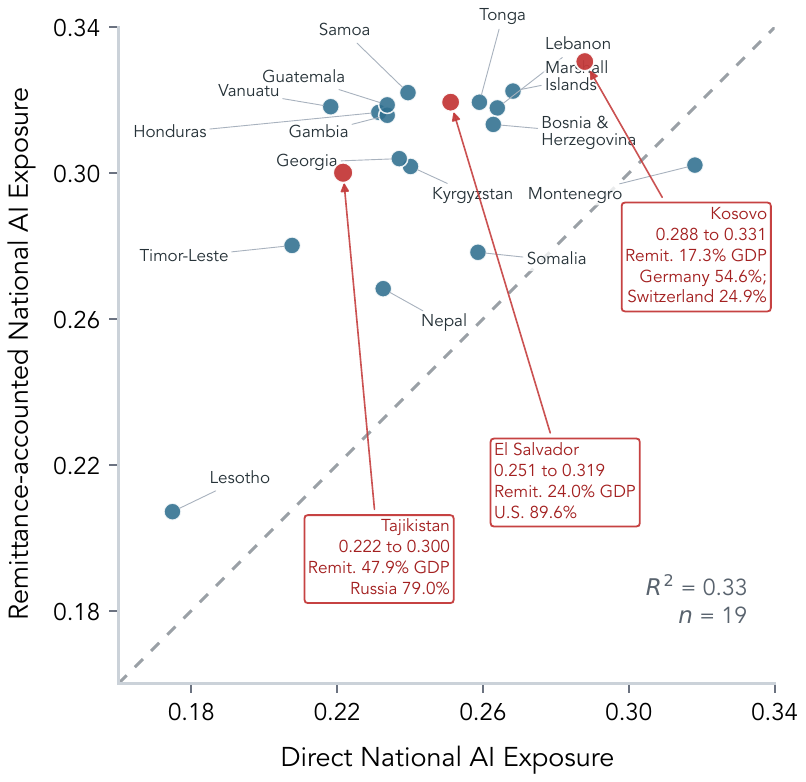
Tajikistan's direct exposure is 0.222. When remittance income is weighted by where migrants work, the score rises to 0.300. Remittances equal 47.9% of GDP, and Russia accounts for 79.0% of covered inflows.
The Jagged Global Economy
Frontier AI is built by a handful of US and Chinese companies, but the technology impacts the economy around the world. We study how labor markets in 141 countries are exposed: how much of a country's current workforce performs tasks that frontier AI can currently help perform? Prior work on the economics of AI often focuses on the US or other developed Western economies, but our work surfaces important heterogeneity between countries. We find that national exposure predicts national AI adoption, that women are more exposed than men, and indirect channels based on country-country relationships can increase exposure.
National AI Exposure
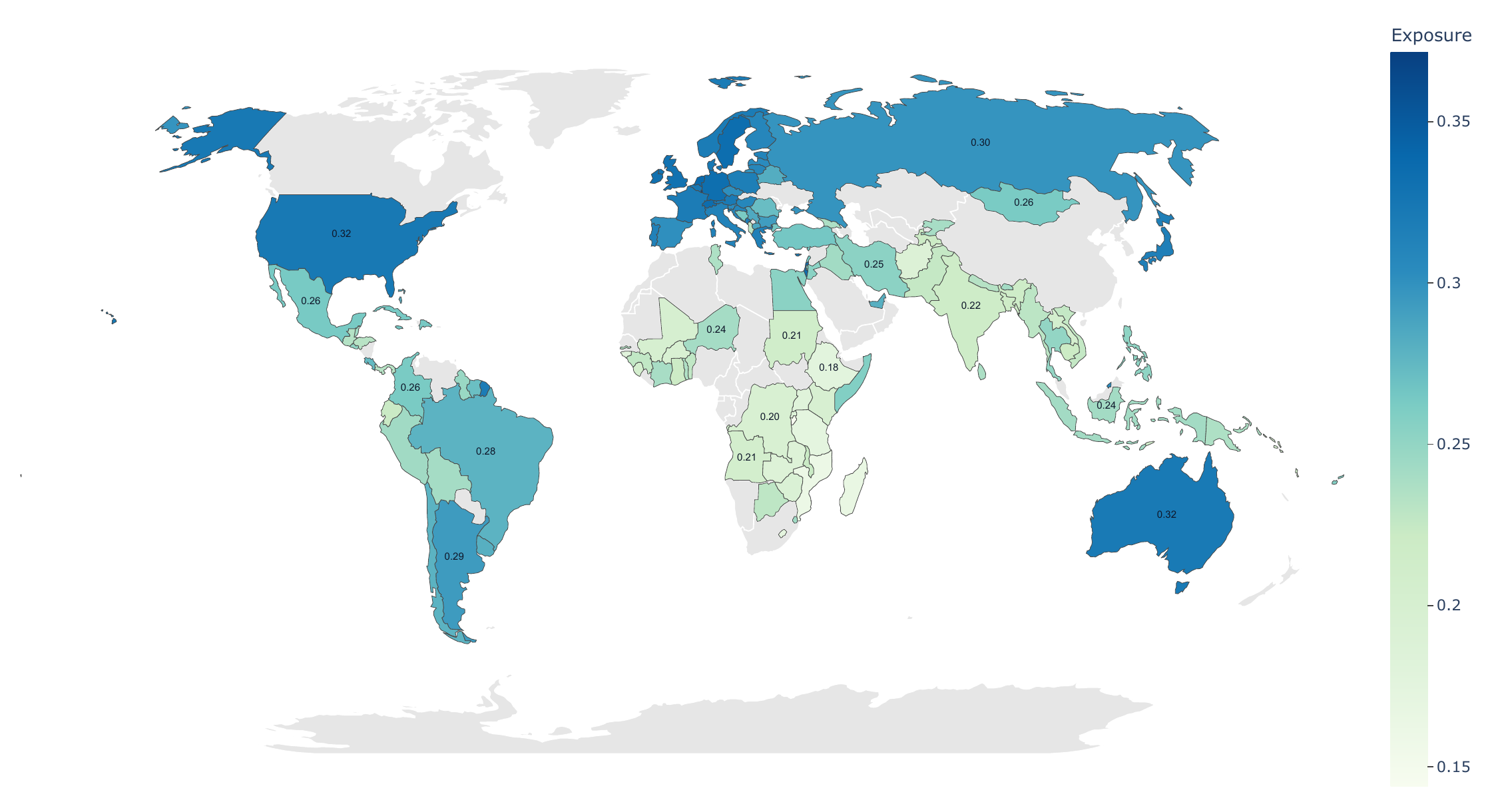
Click a shaded country, or choose one below.
Exposure score
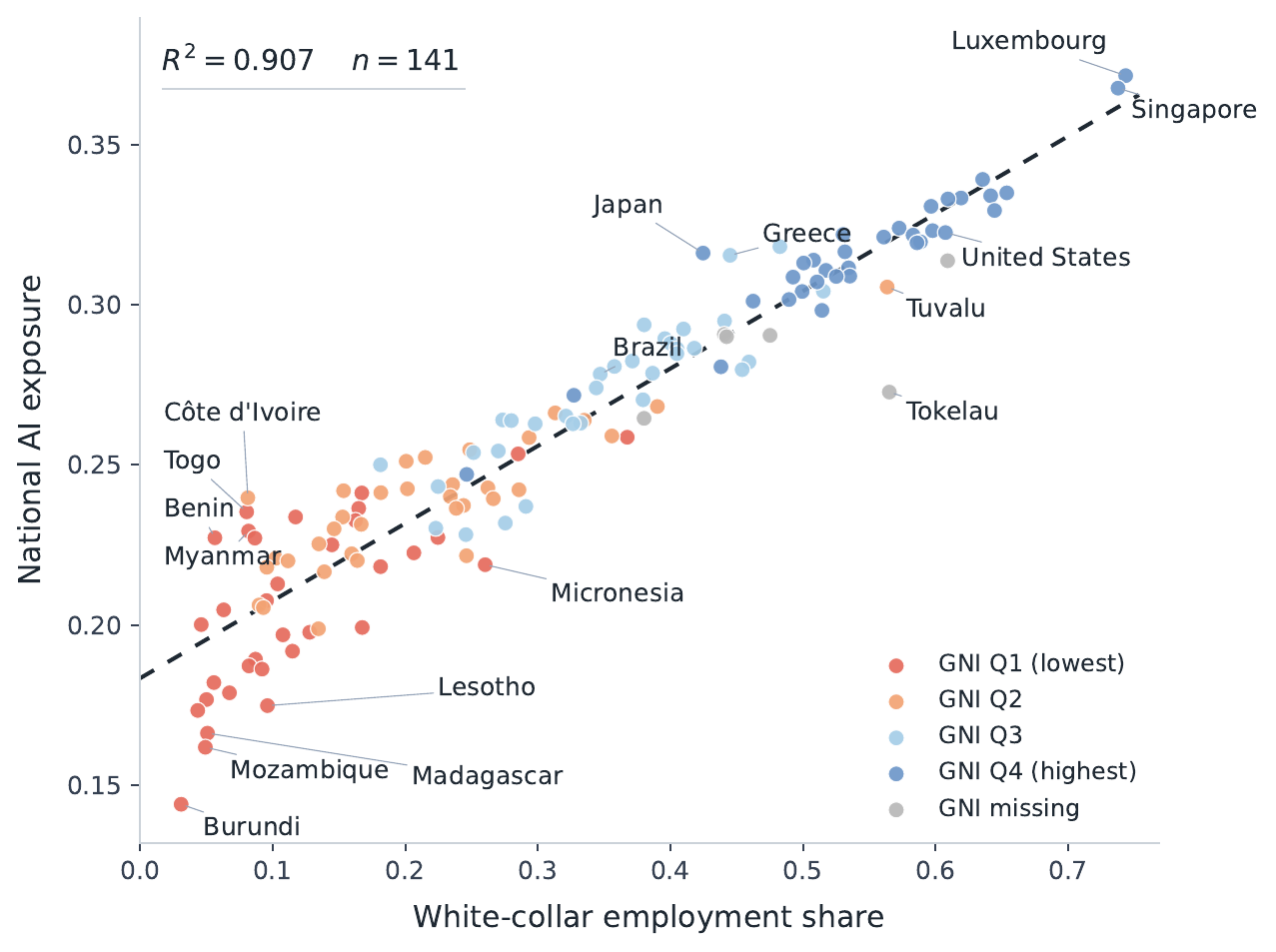
Explaining National AI Exposure
Exposure is strongly tied to workforce composition. Choose one explanation below to see how it relates to national exposure across countries.
The x-axis uses the selected predictor's original units from the release data.
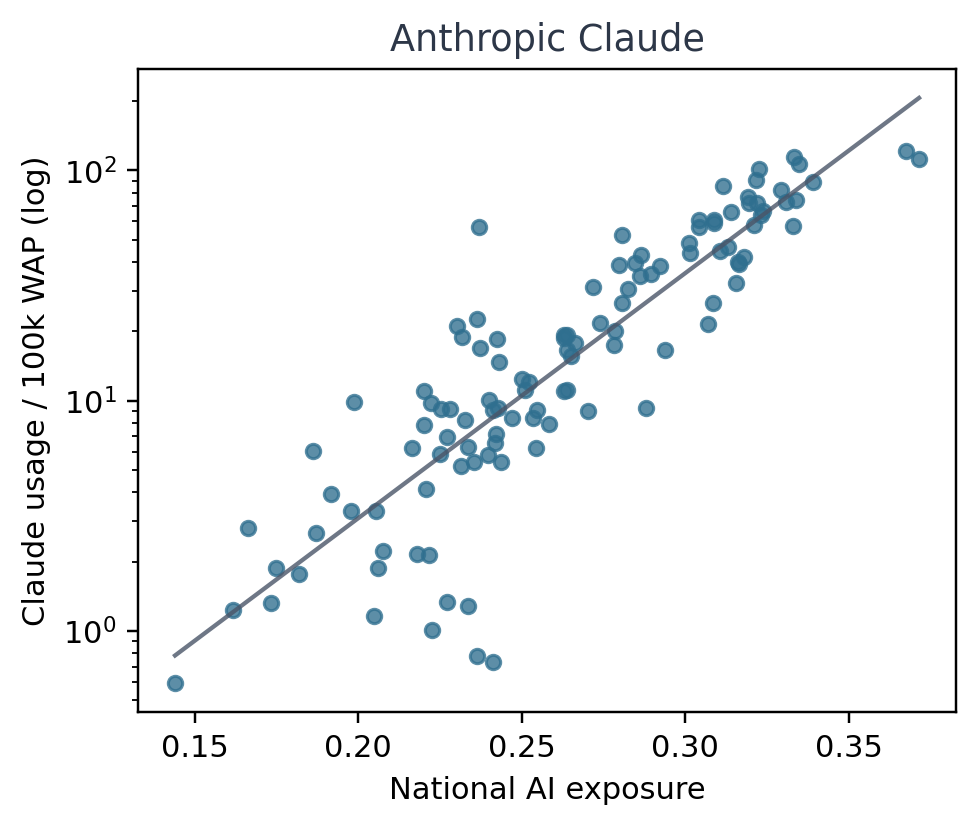
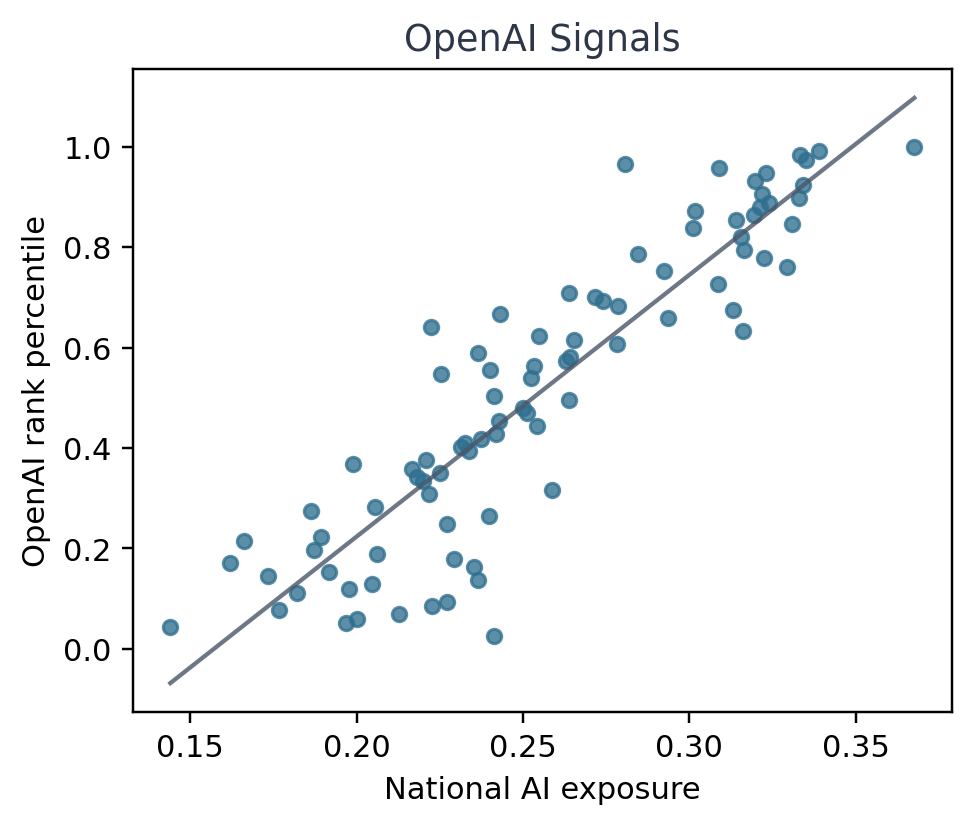
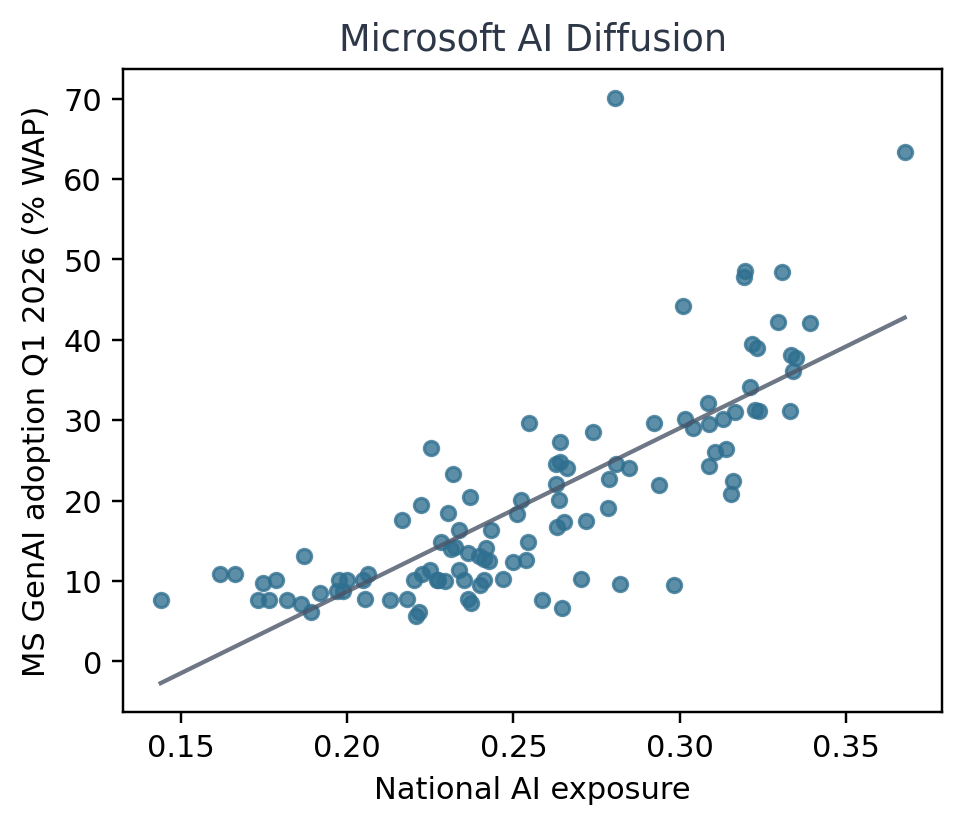
National Exposure Predicts National Adoption
National AI exposure predicts adoption statistics from Anthropic, OpenAI, and Microsoft, even though the three organizations publish different types of country-level usage measures.
Sources: Anthropic Economic Index, OpenAI Signals, and Microsoft AI Diffusion.
Indirect Exposure Through Remittances
Remittances are earnings sent home by migrants. When those transfers are large, families and local businesses may depend partly on jobs in other countries. The remittance-accounted score starts with a country's own workforce exposure, then adjusts it using the exposure of the countries where its migrants earn income. This shows how frontier AI exposure can matter for a country through overseas earnings, not only through jobs within its borders.
Honduras, Guatemala, and El Salvador receive 82.4%, 91.5%, and 89.6% of covered inflows from the United States. Their remittance-accounted exposure scores rise to roughly 0.317-0.319, compared with direct domestic scores of 0.231-0.251.
Citation
@misc{murugan2026jaggedglobaleconomyfrontier,
  title={The Jagged Global Economy: Frontier AI Unevenly Exposes National Economies},
  author={Arul Murugan and Tomás Aguirre and Abhishek Nagaraj and Rishi Bommasani},
  year={2026},
  eprint={2607.05404},
  archivePrefix={arXiv},
  primaryClass={cs.CY},
  url={https://arxiv.org/abs/2607.05404}
}